
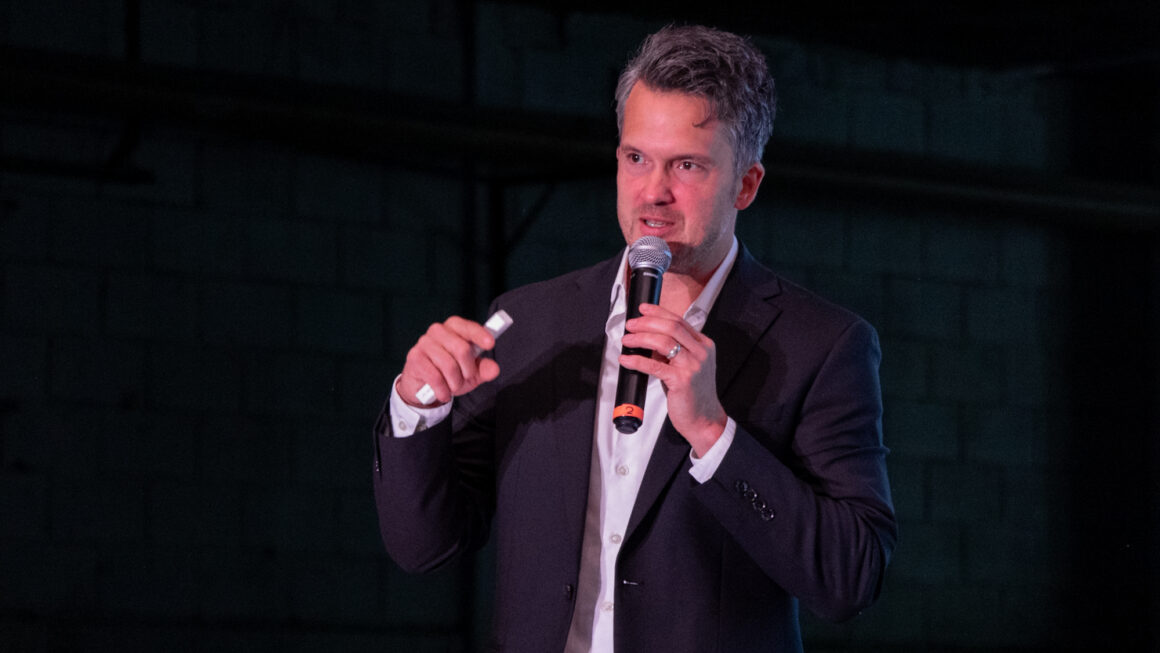
During my conversation with Finian Makepeace about regenerative agriculture at SEED 2026 in Mexico City, there is a moment when the numbers disappear.
He stops talking about acres, carbon, supply chains, and public policy. Instead, he recalls communities that had depended for years on outside assistance for food and water. He remembers seeing images of springs returning after decades of dryness, and of landscapes where healthier soils had begun to restore the movement of water.
Then he becomes emotional.
For Makepeace, regeneration is not an abstract ecological concept. Behind the word are people who can once again grow food, families who regain access to water closer to home, and communities that begin to recover a degree of autonomy.

That moment helps explain much of what he had presented earlier during SEED 2026 in Mexico City.
His argument begins with an uncomfortable statement: sustainability is no longer enough.

From Doing Less Harm to Restoring What Has Been Lost
Around fifteen years ago, Makepeace had a dream that still serves as a personal point of departure for his work.
In it, he was an old man living with his family in a refugee camp in Brazil after climate change had severely destabilized much of the world. One night, his granddaughter found a hole in the fence. They escaped and walked for hours until they reached a city that had been completely destroyed.
His granddaughter looked at him and asked:
“Why did you let this happen?”
Makepeace woke up feeling that one day he needed to have a better answer than simply saying he had not known what to do.
Months later, he encountered the work of soil educator Graeme Sait. Until then, Makepeace explains, much of the environmental work he knew was focused on reducing damage: polluting less, emitting less, destroying less.
Soil health offered him another possibility: reversing decline.
“Sustainability is about doing less harm,” he argues. “Regeneration is about restoring and rebuilding what has been lost.”
The distinction may sound semantic, but for Makepeace it represents a profound change in mindset.
For thousands of years, he argues, many societies have associated the production of food, fiber, and fuel with a gradual decline in the productive capacity of landscapes. Out of that history emerged a logic that treats degradation as inevitable and therefore focuses on conserving whatever remains.
Regeneration asks a different question: what if human activity could help restore the biological capacity of a place?
Soil Is Not an Inert Surface
To explain that possibility, Makepeace returns to something elementary: photosynthesis.
Plants capture carbon from the atmosphere and use solar energy to create organic compounds. Some of those compounds move through the roots into the soil, where they feed communities of microorganisms, including fungi and bacteria, that contribute to soil structure and nutrient cycling.
Healthier soil can absorb more water, sustain greater biological activity, and support further plant growth.
The process can become a virtuous cycle: more plant life, more biological activity below ground, better soil structure, greater water infiltration, and once again, more life.
During his presentation, Makepeace described this through the language of innovation: terrestrial life has had roughly 500 million years of research and development.
Nature has already tested countless solutions.
In a room filled with architects, designers, researchers, and creators, the question becomes especially relevant: how much are we willing to learn from them?

Six Principles of Regenerative Agriculture
Makepeace is careful not to present regenerative agriculture as a formula that can simply be exported everywhere.
During his talk, he outlined six broad principles related to soil health: understanding context, minimizing disturbance, keeping soil covered, maintaining living roots, maximizing diversity, and integrating animals where appropriate.
The first may be the most important: context.
A landscape in England cannot be treated like one in Australia. A tropical region cannot be treated like the Chihuahuan Desert.
Rainfall, species, water cycles, local economies, cultural practices, and knowledge accumulated over generations all shape the way a territory should be managed.
That reflection opened one of the most important themes in our conversation: Indigenous knowledge.
Recovering the Knowledge of Place
Many cultures have developed highly specific ways of producing food and managing land over centuries.
For Makepeace, one recurring error of modernity has been the attempt to export agricultural knowledge without adequately understanding the place where it will be applied.
During our conversation, he turned to colonial history as an example. A colonial power could arrive in a new territory convinced that its agricultural model was superior and reproduce methods created under completely different environmental conditions.
The problem, he argues, has not entirely disappeared.
Corporations, universities, and governments can still assume they possess universally applicable solutions while overlooking knowledge built over generations by the people who actually inhabit a place.
Recognizing that knowledge requires attention to its context, its practical results, and the people who preserve it. There is an ecological memory of place, and it can be lost.
Mexico offers an extraordinary example: the chinampas, one of the most sophisticated agricultural systems developed in Mesoamerica, where soil, water, organic matter, and food production function as part of a territorial infrastructure.
For Makepeace, recovering such knowledge also requires questioning a lingering colonial assumption: that imported knowledge is automatically more legitimate than local knowledge.
Regenerative Agriculture in Mexico
When I ask what role Mexico could play in this transformation, his answer is immediate:
“Not just possible, but essential.”
Mexico is a crucial part of North American food systems. Yet that productive capacity ultimately depends on something that has remained largely invisible beneath our feet: soil health.
Land degradation poses a significant challenge. At the same time, regenerative projects are already exploring different approaches.
Makepeace points to work taking place across northern Mexico’s rangelands. Boomitra, for example, describes a project covering around four million acres across Chihuahua and Sonora, working with ranching families through practices that include rotational grazing.
These Mexican landscapes form part of a wider international effort. As Makepeace later clarified by email, Boomitra’s additional contribution to One Billion Acres is a global commitment, rather than a commitment covering Mexico alone.
The importance of these projects also lies in their economic implications.
Regeneration has to make sense for the people responsible for putting it into practice.
Ecology Also Has to Work Economically
One of Makepeace’s most pragmatic arguments is that no movement can expand if the people implementing it are forced to lose money.
Farmers still need viable businesses.
Gradually reducing dependence on certain fertilizers and other external inputs can lower costs, he explains, while allowing biological processes in the soil to recover. The transition depends on local conditions and the needs of each farm.
Regeneration therefore becomes a conversation about profitability, water security, resilience, biodiversity, supply chains, and human health.
For Makepeace, this broader frame is one of the major changes of the past fifteen years.
Farmers, companies, governments, investors, and consumers are entering the same space.
And that creates another problem: how do they find one another?

The Ryzosphere: Building the Missing Infrastructure
Makepeace is also involved with The Ryzosphere, a platform designed to connect different actors within regenerative food and agriculture systems.
His comparison is simple.
Today, if someone wants to stay in another city, they can open Airbnb and find accommodation without personally knowing the owner.
Agriculture often still works more like an old Rolodex.
A company looking for regenerative wheat might end up calling someone who knows someone who knows a farmer. The same is true for processors, transportation, storage, certification, and other services.
The Ryzosphere is intended to make those connections visible and use technology to help producers, buyers, and service providers find one another more efficiently.
Artificial intelligence enters this picture as a tool for connecting a fragmented system, helping people locate the relationships and resources they need.
Politics Also Needs Stories
For years, Makepeace has also worked in public policy and advocacy.
That experience led him to a formula he summarizes through three ideas: storytelling, relationships, invitation.
Tell stories. Build relationships. Invite people in.
For him, being right does not guarantee that an idea will become public policy.
Communication requires understanding the person on the other side. It also means building relationships with people who make decisions and, sometimes, helping them do the practical work required to turn a concern into policy.
Makepeace remembers beginning from a more traditional activist position, largely outside the system. Over time, he came to understand that protest can matter, but so can entering the room when there is a real opportunity for dialogue.
He also realized that many environmental leaders simply did not know much about soil health.
Sometimes the obstacle was a lack of exposure to the subject.
That is why he emphasizes invitation.
Finian Makepeace, Storytelling and Regenerative Agriculture
One of the most relevant ideas in his presentation for those of us who work in media, culture, and communication is the distinction he makes between a leader and a champion.
A leader develops knowledge, practices, or solutions. A champion helps translate those ideas so that other people can understand and engage with them.
Not everyone needs to become a soil scientist. We also need people who can recognize an important idea, understand why it matters, and carry it to new audiences.
Makepeace knows that territory well.
He was a musician before becoming involved in the regenerative movement. Then came Kiss the Ground, the training of thousands of soil advocates, and films that helped move these ideas into mainstream culture.
Kiss the Ground, Common Ground, and Groundswell emerged from a creative partnership between directors Rebecca Tickell and Josh Tickell and producers Finian Makepeace and Ryland Engelhart, who helped inspire and shape the films from their inception.

Together, these films have brought soil health, the experiences of farmers, and the possibilities of regenerative agriculture to wider audiences. Groundswell expands that story through international examples, connecting the movement to landscapes and communities across the world.
For Makepeace, storytelling is part of the infrastructure of change. A film can give unfamiliar ideas a human face, make complex processes understandable, and invite viewers to imagine their own participation.
One Billion Acres: 351 Million Acres Toward a Global Goal
The campaign connected to Groundswell, One Billion Acres, aims to bring one billion acres of agricultural and grazing land into commitments to regenerative practices by 2030.

For the initiative, that scale represents roughly 10 percent of global agricultural land, a threshold its organizers believe could help accelerate broader adoption.
During the Thursday evening screening event in Mexico City, Boomitra committed 20 million acres to the initiative. In a subsequent email, Makepeace confirmed that this addition brought the campaign’s reported total to 351 million acres.
He also clarified what Boomitra’s contribution includes: 10 million acres already in its program and another 10 million acres committed by 2030.
Boomitra’s contribution is global, rather than limited to Mexico, and combines land already participating in its program with commitments for future expansion. It does not mean that 20 million additional acres have already completed a regenerative transition.

The ambition is enormous. So is the challenge.
Land degradation affects food security, water security, biodiversity, and the long-term viability of communities. Turning a campaign of this scale into lasting change requires sustained work on the ground, alongside the public visibility generated by the films.
When the Water Comes Back
This is where our conversation leaves abstraction behind.
Makepeace begins talking about communities that had depended for years on outside food and water assistance. He talks about places where children had to travel long distances to collect water, and about landscapes where restoring soil health began to change that reality.
He remembers receiving images of a spring that had been dry for decades and had started flowing again.
His voice changes.
He pauses.
He cries.
For a few seconds, regeneration becomes something immediate: water, food, autonomy, the possibility of remaining in one’s own territory.
Makepeace connects ecological decline with poverty, migration, displacement, and dependency. When communities lose fertile soil and reliable water, he argues, they also begin to lose control over their own future.
That is why he considers some humanitarian responses incomplete when they address only the emergency.
Digging a well can save lives. Restoring the ecological processes that allow water to infiltrate, remain in the landscape, and circulate again can also help address the conditions behind that emergency.
For him, regeneration carries that possibility of repair.
From Soil to Architecture
SEED brought together architects, designers, material researchers, and creators whose work might initially seem distant from agriculture.
Makepeace sees connections.
An architect can ask where materials come from, what landscapes produce them, what processes make them available, and what impacts those systems create.
Regeneration can therefore become a design criterion: what can a project help improve in the places and systems on which it depends?
For someone who began as a musician, the idea that participation belongs only to certain specialists makes little sense.
His invitation is broader: there is a place for everyone.
That invitation also reaches cultural media. The stories we choose to document can make relationships visible: between a building and a landscape, between a meal and the soil that produced it, between the survival of a community and the movement of water through its territory.
The Question That Remains
Toward the end of our conversation, I ask him what everyday life might look like if regeneration succeeds over the next twenty or thirty years.
His answer is surprisingly modest.
For many people, the change may not feel spectacular. It could mean more local food, cleaner water, greater biodiversity, or more resilient supply chains.
But for people currently living in severely degraded territories, the difference could be profound.
It could mean recovering water, growing food again, remaining on the land, and regaining autonomy.
Perhaps that is the most compelling possibility in Makepeace’s account of regeneration: that certain things can return.
A spring. A grassland. The fertility of a soil. A community’s capacity to shape its future.
The image that stays with me is the spring he described. Water flowing again in a place where people had learned to live with its absence.
Watch Groundswell on Prime. Visit the official film website for viewing information, and explore One Billion Acres to learn more about the campaign.
This article draws on an interview with Finian Makepeace and his presentation at SEED 2026 in Mexico City, supplemented by materials and subsequent factual clarifications provided by Makepeace and his team.
Gabriela Gallegos en el Maratón de la Gran Muralla China: correr para descubrir el mundo
Gabriela Gallegos cumplió un sueño de más de 20 años al correr el Maratón de la Gran Muralla China.
Marcelo Rosenbaum y el diseño que comienza al pedir permiso
Marcelo Rosenbaum reflexiona sobre diseño, memoria artesanal y autonomía comunitaria en una conversación durante SEED 2026.
VIVA FRIDA en MALBA: una conversación con Elina Costantini
La exposición VIVA FRIDA llega al MALBA de Buenos Aires. Elina Costantini revela cómo nació el proyecto y la historia detrás de los vestidos, objetos personales y obras de Frida Kahlo.

ABYA Madrid: arte y gastronomía en el Palacio de Saldaña
En el Palacio de Saldaña, ABYA reúne más de 200 obras y una cocina entre España y Latinoamérica, guiada por Manuel González y Óscar Castellano.

Mockups Before Fuckups: diseño y proceso en el Franz Mayer
¿Qué sucede antes de que un objeto llegue a su forma definitiva? Mockups Before Fuckups, en el Museo Franz Mayer, recorre quince años de JDE design driven consultancy para revelar maquetas, prototipos, errores, decisiones y aprendizajes detrás del trabajo de Jorge Diego Etienne.
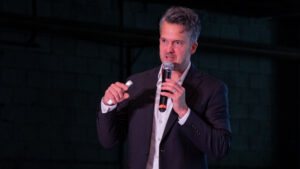
Finian Makepeace Regenerative Agriculture Beyond Sustainability
Finian Makepeace discusses regenerative agriculture, soil health, Indigenous knowledge and the power of storytelling in an interview at SEED 2026 in Mexico City.
